If you’re looking for something different, then this beautifully bizarre love story that exposes the ugly side of human nature is perfect. Wicker is a magnificent, visually captivating, and wonderfully untraditional love story that dares to explore the complicated relationship between individuality and social acceptance.
Wicker Movie Review
There are movies that leave you speechless, movies that leave you emotional, and then there are movies that leave you asking yourself, “WTF did I just watch?” Somehow, Wicker manages to accomplish all three. What initially appears to be an absurd and unconventional love story quickly reveals itself as something far more meaningful. Beneath its bizarre premise lies an emotional, thought-provoking exploration of social acceptance, jealousy, envy, and the unfortunate lengths people will go when they feel threatened by someone else’s happiness. It’s weird, it’s beautiful, and surprisingly, it has a whole lot of heart.
Directed by Alex Huston Fischer and Eleanor Wilson, Wicker follows a lonely fisherwoman (Olivia Colman) who, after enduring years of judgment and ridicule from the people of her small village, commissions a local basketmaker (Peter Dinklage) to create her the perfect husband, made entirely out of wicker. Yes, you read that correctly. What follows is a wildly imaginative romance that challenges the community’s understanding of love, companionship, and what it means to truly be happy.
What I found particularly fascinating about Wicker is how brilliantly Fischer and Wilson approach such an outrageous concept with a surprisingly subtle tone. Rather than allowing the film’s absurdity to overshadow its message, the directing duo embraces the unusual premise with remarkable restraint. There is a delicate balance between the film’s dark humor, emotional vulnerability, and underlying social commentary that makes the experience feel strangely authentic. The filmmakers never seem interested in convincing us that this relationship is normal. Instead, they challenge us to question why it needs to be.
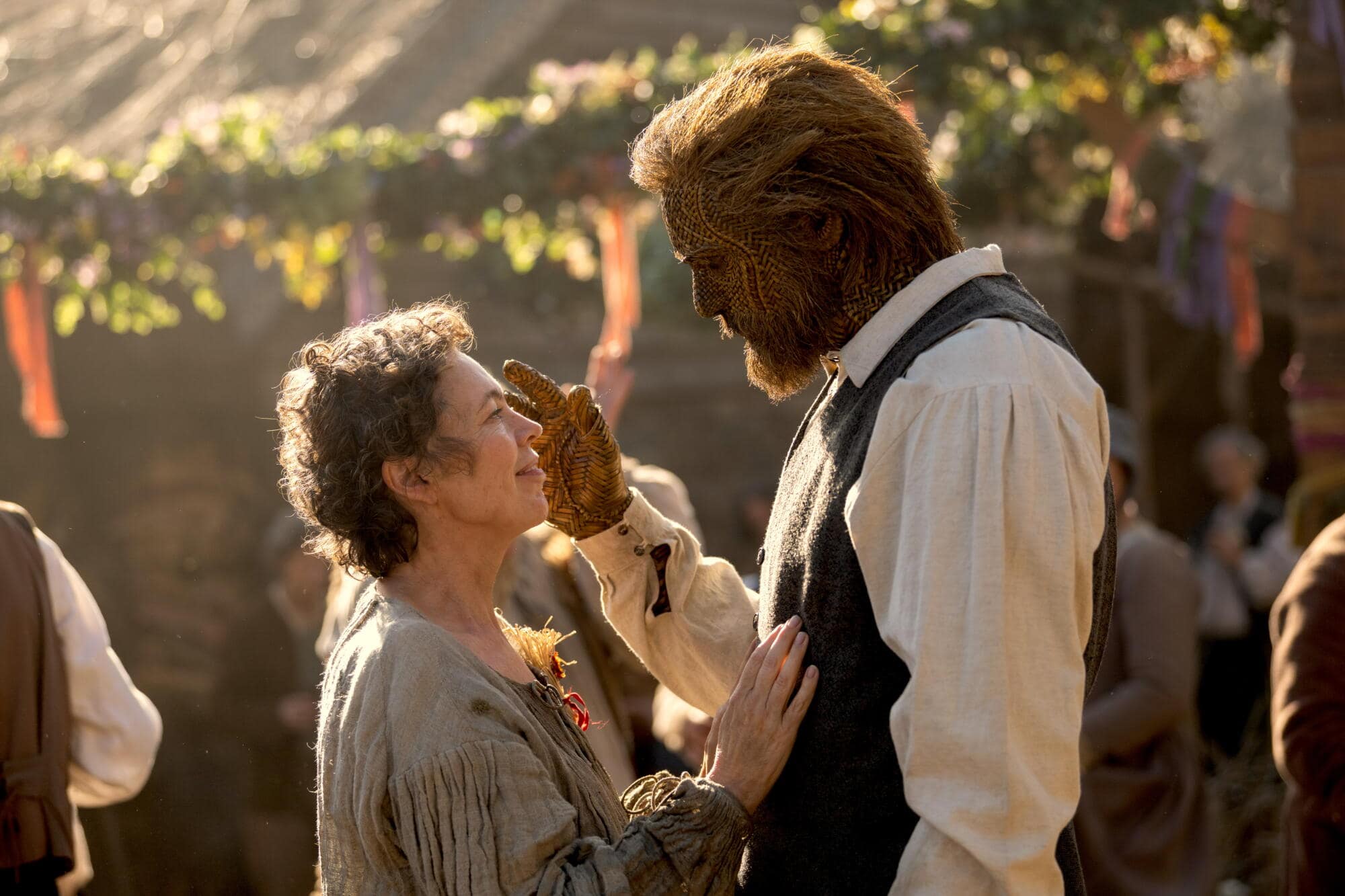
Visually, Wicker is absolutely stunning. The cinematography, courtesy of Lol Crawley, brings an almost storybook quality to the film, creating a world that feels both fantastical and grounded. From the beautifully composed environments to the intricate details of the village, every frame contributes to the film’s peculiar charm. However, one of its greatest visual achievements is undoubtedly Alexander Skarsgård’s appearance as the Wicker Husband.
The craftsmanship behind Skarsgård’s transformation is nothing short of magnificent. His woven features, textured body, and remarkably expressive appearance make him feel like a living piece of art. It’s the kind of character design that could have easily become distracting or unintentionally comical, yet the filmmakers manage to make his presence feel natural within this strange little world. Even more impressive is how Skarsgård brings genuine warmth and tenderness to a character whose physical appearance should make emotional connection nearly impossible. His performance reminds us that humanity isn’t necessarily defined by what we’re made of, but by how we treat others.
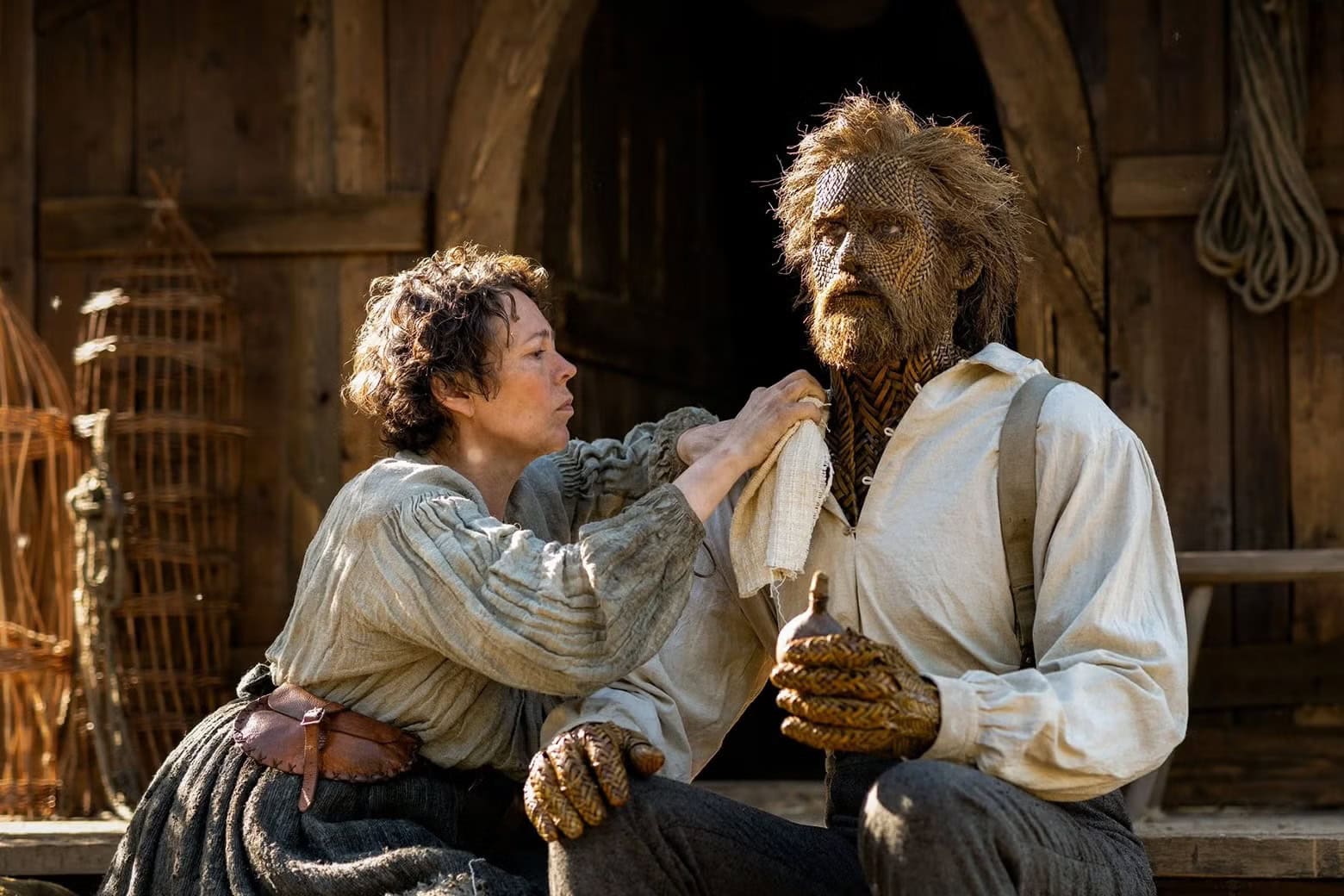
Of course, the emotional foundation of the film rests heavily on the shoulders of the brilliant Olivia Colman, who delivers yet another outstanding performance. Colman has an incredible ability to make even the most eccentric characters feel relatable, and her portrayal of the fisherwoman is no exception. Beneath her character’s rough exterior is a woman who simply wants to experience the love, affection, and companionship that everyone around her seems entitled to. Colman beautifully captures the vulnerability of someone who has spent so much of her life being dismissed that even the possibility of happiness feels unfamiliar.
Watching her character gradually embrace that happiness is what makes this unconventional romance so easy to root for. There is something genuinely touching about witnessing someone who has been treated as an outsider finally discover a sense of belonging. Colman and Skarsgård share an unexpectedly beautiful chemistry that allows the emotional weight of their relationship to shine through even the film’s strangest moments.
Then there’s Elizabeth Debicki, who delivers a brilliantly calculated performance as the Tailor’s Wife, one of the film’s primary antagonistic forces. Debicki’s cold demeanor, judgmental attitude, and quiet sense of superiority make her character incredibly effective. She represents the ugly side of social acceptance, where the happiness of others becomes a threat simply because it challenges established expectations.
What makes her performance particularly compelling is that her character doesn’t need to be outwardly monstrous to become someone you genuinely despise. Her expressions, calculated behavior, and ability to influence the people around her speak volumes. With the help of the rest of the village, she creates an atmosphere of resentment that makes you cheer for Colman’s underdog love story even more. The more the community attempts to undermine this unusual relationship, the more you find yourself emotionally invested in seeing it succeed.
And that, to me, is where Wicker becomes something truly special.
At its core, the film is a bold narrative study of human behavior. It explores how easily jealousy and envy can disguise themselves as moral judgment, particularly when people encounter something they don’t understand. Rather than celebrating someone else’s happiness, the villagers become consumed by their inability to comprehend it. Their resentment exposes a familiar and uncomfortable truth about society: sometimes people would rather destroy what makes someone else happy than confront what is missing from their own lives.
It’s a powerful message wrapped inside one of the most bizarre romantic fantasies I’ve seen in quite some time.
What I appreciate most is that Wicker doesn’t feel the need to beat audiences over the head with its themes. The filmmakers allow the characters, performances, and visual storytelling to communicate much of what the film has to say. There are moments that will make you laugh at the sheer ridiculousness of what’s unfolding, only for the next scene to unexpectedly pull at your heartstrings. That unpredictable emotional balance is part of what makes the experience so memorable.
Final Verdict
Wicker is a magnificent, visually captivating, and wonderfully untraditional love story that dares to explore the complicated relationship between individuality and social acceptance. With brilliant performances from Olivia Colman, Alexander Skarsgård, and Elizabeth Debicki, alongside the beautifully restrained direction of Alex Huston Fischer and Eleanor Wilson, the film transforms an absolutely ridiculous premise into a surprisingly profound reflection on love, jealousy, and human nature.
It’s the kind of movie that might leave you questioning what you just witnessed, but the more you think about it, the more you begin to appreciate what it was trying to say. Because sometimes the strangest love stories reveal the simplest truths about humanity. And perhaps the biggest question Wicker leaves us with isn’t whether a woman can fall in love with a man made of wicker, but why her happiness bothers everyone else so damn much.
WICKER is now playing in theaters nationwide. If you’re looking for something refreshingly different, beautifully strange, and unexpectedly heartfelt, this is one love story worth experiencing on the big screen.
Reporter: Keith ‘Klep’ Napier. He is the CEO and Editor-in-Chief of Critix. You can find his reviews, interviews, and other cool works at WeAreCritix.com, as well as on social: Twitter, Instagram, Facebook, and Youtube.



Leave a Reply